9 Topics
 5 Days
 45 Sessions
Programme Overview
Training Description
Who should attend
- Compliance and risk professionals
- Public-sector managers and administrators
- Project and programme managers
- Governance and integrity officers
- Anti-corruption and investigations professionals
- County and local-government officials
- Development-sector and NGO finance professionals
- Senior executives responsible for public resources
- Professionals involved in budget planning, allocation, monitoring, and oversight
Session Objectives
- Identify key risk areas and vulnerabilities in the budget allocation process. Implement robust internal controls to prevent fraud and misuse. Strengthen transparency and accountability through public reporting. Analyze the legislative and policy frameworks that combat corruption. Use data analytics and technology for fraud detection.
About the Course
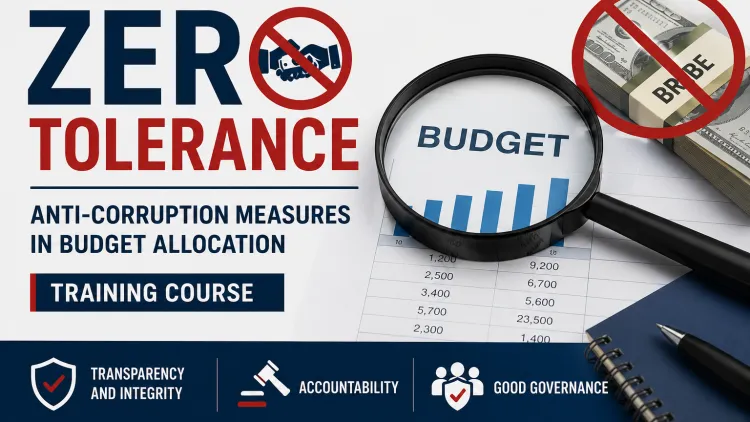
Zero Tolerance: Anti-Corruption Measures in Budget Allocation Training is a specialized professional programme designed to equip public-sector officials, finance professionals, budget officers, procurement teams, auditors, managers, and governance practitioners with the knowledge and practical tools required to prevent, detect, and respond to corruption risks throughout the budget allocation process.The course examines how corruption, conflicts of interest, political interference, procurement manipulation, fraud, favoritism, and weak controls can undermine public-resource allocation. Participants will explore practical approaches to strengthening transparency, accountability, ethical decision-making, internal controls, risk assessment, oversight, reporting mechanisms, and integrity throughout the budget cycle.
Curriculum & Topics
9 Topics | 45 Sessions
-
 Workshop 1.1:
Defining corruption and its impact on public funds
Workshop 1.1:
Defining corruption and its impact on public funds
-
Workshop 1.2:
Common corruption schemes in budget allocation and execution
-
Workshop 1.3:
The link between corruption and poor service delivery
-
Workshop 1.4:
International conventions and anti-corruption standards
-
Workshop 1.5:
The psychological and social dimensions of corruption
-
Workshop 2.1:
Identifying high-risk areas in the budget cycle
-
Workshop 2.2:
Conducting a corruption vulnerability assessment
-
Workshop 2.3:
Mapping key decision-making points and their associated risks
-
Workshop 2.4:
Using risk matrices to prioritize control measures
-
Workshop 2.5:
Case studies of budget-related corruption scandals
-
Workshop 3.1:
Analysis of national anti-corruption laws and regulations
-
Workshop 3.2:
The role of legal institutions in prosecuting corruption
-
Workshop 3.3:
Frameworks for asset declaration and conflict of interest
-
Workshop 3.4:
Public procurement laws and their role in preventing corruption
-
Workshop 3.5:
The importance of a strong legal mandate for oversight bodies
-
Workshop 4.1:
Designing and implementing effective financial controls
-
Workshop 4.2:
The principle of segregation of duties
-
Workshop 4.3:
Internal audit as a key anti-corruption tool
-
Workshop 4.4:
Best practices for managing public contracts and payments
-
Workshop 4.5:
Technology's role in automating and monitoring controls
-
Workshop 5.1:
The importance of open budget data and fiscal transparency
-
Workshop 5.2:
Mechanisms for public access to budget information
-
Workshop 5.3:
The role of the media and civil society in public scrutiny
-
Workshop 5.4:
Publishing budget documents in a clear and accessible format
-
Workshop 5.5:
Citizen participation in monitoring budget execution
-
Workshop 6.1:
The functions of Supreme Audit Institutions
-
Workshop 6.2:
Parliamentary oversight of budget allocation and expenditure
-
Workshop 6.3:
Different types of audits: financial, performance, and forensic
-
Workshop 6.4:
Responding to and implementing audit recommendations
-
Workshop 6.5:
The power of public audits in holding officials accountable
-
Workshop 7.1:
Using data mining to detect anomalies and red flags
-
Workshop 7.2:
Implementing e-procurement systems to increase transparency
-
Workshop 7.3:
The role of blockchain and distributed ledger technology
-
Workshop 7.4:
Integrating data from various sources for a holistic view
-
Workshop 7.5:
Developing dashboards for real-time budget monitoring
-
Workshop 8.1:
The role of leadership in setting the tone for integrity
-
Workshop 8.2:
Developing and enforcing codes of conduct and ethics
-
Workshop 8.3:
Training and awareness programs for all public employees
-
Workshop 8.4:
Creating a reward system for ethical behavior
-
Workshop 8.5:
Building a sustainable culture of accountability and public service
-
Workshop 9.1:
Establishing confidential reporting and whistleblower channels
-
Workshop 9.2:
Protecting whistleblowers from retaliation
-
Workshop 9.3:
Procedures for investigating allegations of corruption
-
Workshop 9.4:
Inter-agency cooperation in corruption investigations
-
Workshop 9.5:
The process of disciplinary action and legal recourse