7 Topics
 5 Days
 35 Sessions
Programme Overview
Training Description
Senior Managers & Executives: Responsible for organizational strategy and high-level decision-making during a crisis.
Crisis Management/Communication Teams: Those who directly manage and communicate during an emergency.
Business Continuity & Resilience Professionals: Individuals responsible for developing and testing continuity plans.
Heads of Department (HODs): Leaders who manage specific functions affected by a crisis (e.g., IT, HR, Operations).
Public Relations & Media Specialists: Personnel tasked with managing the organization's public image and media response.
Risk Management Specialists: Those who identify and mitigate potential threats and risks to the organization.
Security and Emergency Response Personnel: Staff involved in the immediate, on-the-ground response to incidents
Session Objectives
- Validate existing crisis response plans. Enhance decision-making under severe pressure. Improve team coordination and communication flow. Develop effective media and stakeholder communication strategies. Identify resource gaps and procedural weaknesses. Build individual and organizational confidence in handling crises.
About the Course
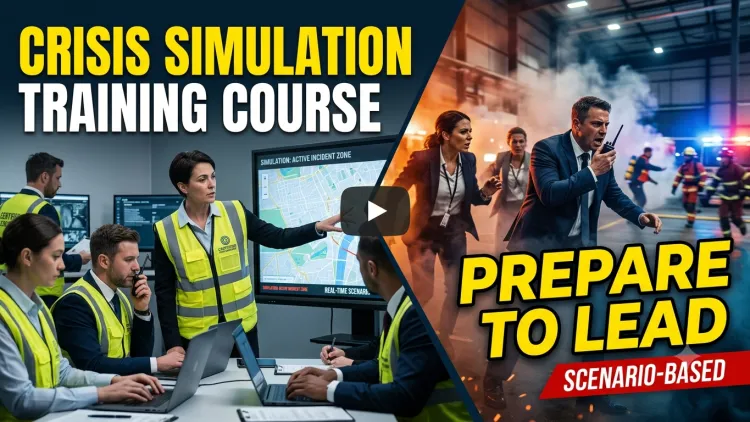
Prepare your leadership and emergency teams for high-stakes threats through live-action simulations and dynamic scenario exercises. This intensive course tests your organization's crisis management plans against realistic media pressure and rapid decision-making challenges. Participants will acquire practical skills in rapid threat assessment, multi-stakeholder communication, and strategic coordination—equipping your organization to pinpoint response gaps and handle real-world emergencies with confidence.
Curriculum & Topics
7 Topics | 35 Sessions
-
 Workshop 1.1:
Defining crisis simulation and its role in enhancing organizational resilience.
Workshop 1.1:
Defining crisis simulation and its role in enhancing organizational resilience.
-
Workshop 1.2:
Understanding the benefits of scenario-based training over traditional methods.
-
Workshop 1.3:
Exploring different types of crisis simulations (e.g., tabletop, functional, full-scale).
-
Workshop 1.4:
Setting clear objectives for crisis simulation exercises.
-
Workshop 1.5:
Setting clear objectives for crisis simulation exercises.
-
Workshop 2.1:
Methodologies for developing compelling and challenging crisis scenarios.
-
Workshop 2.2:
Identifying relevant threats and vulnerabilities for scenario development.
-
Workshop 2.3:
Crafting realistic injects and dynamic event sequences for simulation.
-
Workshop 2.4:
Tailoring scenarios to specific organizational risks and objectives.
-
Workshop 2.5:
Ensuring the scenario promotes critical thinking and decision-making.
-
Workshop 3.1:
Understanding the key roles in a crisis simulation (e.g., players, facilitators, evaluators).
-
Workshop 3.2:
Defining responsibilities for each role to ensure effective exercise execution.
-
Workshop 3.3:
Briefing participants on their roles and the scenario parameters.
-
Workshop 3.4:
Establishing clear communication protocols within the simulation environment.
-
Workshop 3.5:
Fostering a collaborative yet challenging atmosphere for participants.
-
Workshop 4.1:
Techniques for effective facilitation during a live crisis simulation.
-
Workshop 4.2:
Managing real-time injects and adapting the scenario based on participant actions.
-
Workshop 4.3:
Guiding participants through decision points and complex problem-solving.
-
Workshop 4.4:
Maintaining control of the simulation while allowing for organic responses.
-
Workshop 4.5:
Best practices for keeping participants engaged and focused.
-
Workshop 5.1:
Exploring various technologies and tools used in crisis simulation.
-
Workshop 5.2:
Utilizing communication platforms (e.g., virtual command centers) for distributed teams.
-
Workshop 5.3:
Integrating realistic media injects (simulated news reports, social media feeds).
-
Workshop 5.4:
Understanding simulation software for managing complex scenarios.
-
Workshop 5.5:
Leveraging data analytics to track performance during simulations.
-
Workshop 6.1:
The critical importance of the debriefing phase in scenario-based training.
-
Workshop 6.2:
Methodologies for conducting effective debriefings (e.g., Hot Washes, AARs).
-
Workshop 6.3:
Translating lessons learned into actionable recommendations for plans and procedures.
-
Workshop 6.4:
Translating lessons learned into actionable recommendations for plans and procedures.
-
Workshop 6.5:
Fostering a culture of continuous learning and improvement.
-
Workshop 7.1:
Developing a program for regular crisis simulations and scenario-based training.
-
Workshop 7.2:
Integrating insights from simulations into existing crisis management plans.
-
Workshop 7.3:
Using simulations to validate and refine emergency response protocols.
-
Workshop 7.4:
Measuring the return on investment of crisis simulation training.
-
Workshop 7.5:
Championing scenario-based training as a core component of organizational resilience.